
Comparing products on Amazon India is not the same as sorting a page by stars or price. The useful choice depends on what you need the product to do, how often you will use it, who is selling it, what happens if it fails, and whether the exact variant can be returned or replaced.
This guide is designed for Indian shoppers comparing fashion, beauty, home, workspace, travel, fitness, and everyday products. It gives you a repeatable method that works before the shortlist becomes a pile of tabs.
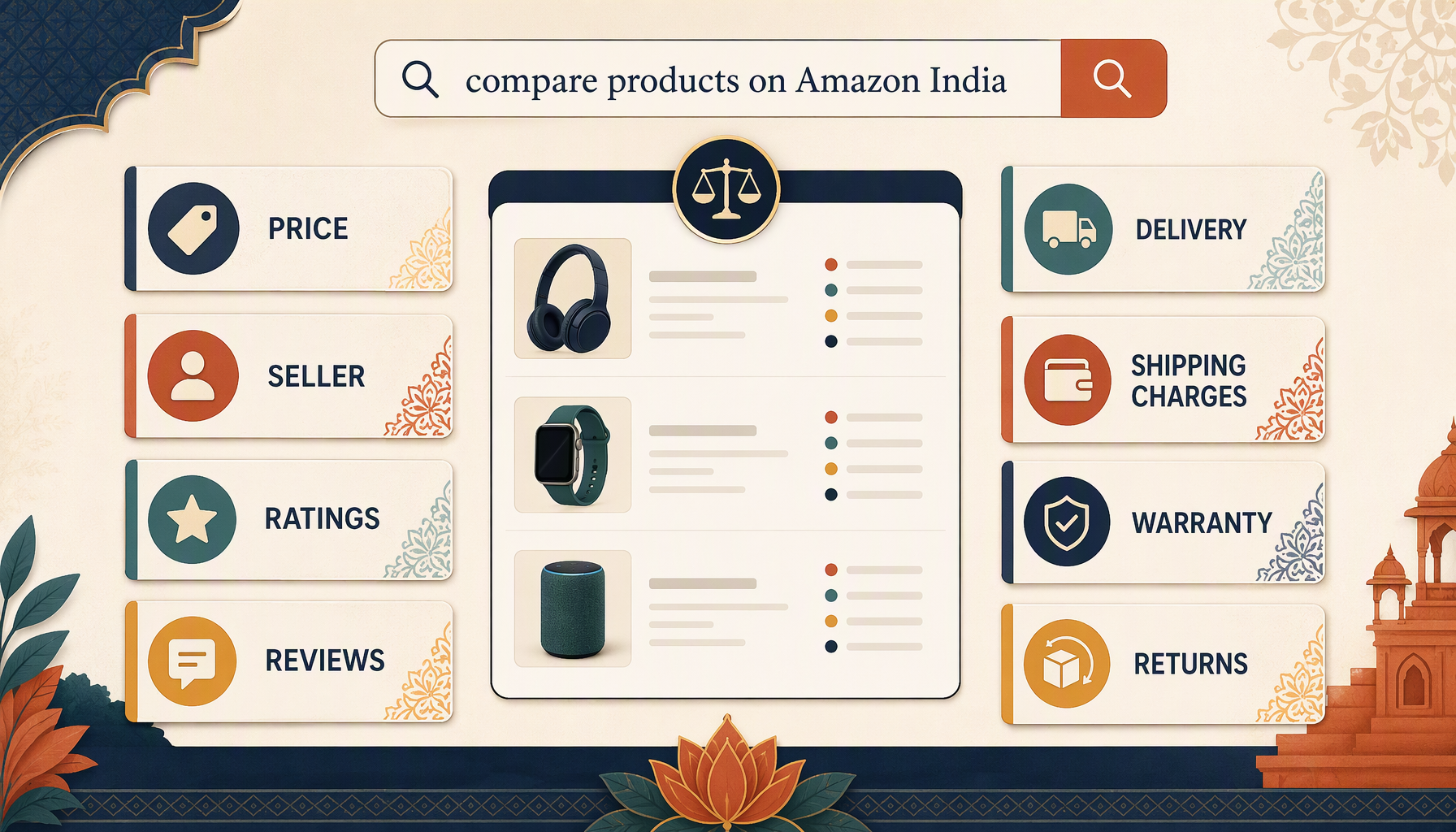
Problem: too many products, not enough decision clarity
Amazon India can show dozens of similar-looking options for the same search. The problem is not a lack of information. It is that the information is arranged around listings and features rather than your actual decision. A low price may hide delivery limits, weak warranty support, missing accessories, or a product that does not fit your routine.
Journey: from need to safe purchase
- Name the situation: work, commute, wedding, home, travel, fitness, gift, or everyday use.
- Write the non-negotiables: size, capacity, material, compatibility, comfort, warranty, or return requirement.
- Shortlist three or four different tradeoffs instead of ten near-identical products.
- Verify the exact seller, variant, delivery, price, warranty, and return information.
- Choose the product that fits the use and risk, not the product with the loudest claim.
Failure point: when a rating becomes a substitute for evidence
Ratings can help with initial screening, but a rating does not tell you whether a bag fits your laptop, a chair suits your desk height, a beauty shade suits your routine, or a fitness product is easy to clean. Reviews can also combine multiple variants. Treat ratings as one signal, then verify the details that affect your actual use.
Five questions that make an Amazon India comparison useful
| Question | What to check | Why it matters |
|---|---|---|
| What job must it do? | Use case, frequency, environment, user, and duration. | Prevents buying a product that only matches the keyword. |
| What must fit? | Measurements, capacity, compatibility, size chart, or shade. | Reduces variant and return risk. |
| Who is accountable? | Seller, manufacturer warranty, replacement process, and invoice. | Price is less useful if support is unclear. |
| What will it cost to own? | Delivery, accessories, consumables, care, repair, and replacement. | Shows value beyond the product-page price. |
| What can go wrong? | Return limits, damage, fit, compatibility, heat, moisture, or serviceability. | Turns uncertainty into a conscious tradeoff. |
Choose the comparison path that fits
Fashion and beauty
Prioritise measurements, fabric, opacity, shade or finish, climate, care, return restrictions, and how the item works with what you already own. Product photographs are not fit evidence.
Home and workspace
Check dimensions, load, assembly, power or compatibility, warranty, repairability, delivery damage risk, and the space or surface where the product will be used.
Travel and everyday carry
Check empty weight, capacity, dimensions, weather exposure, straps or handles, security, cleaning, and whether the item fits the actual transport or commute.
Fitness and routine products
Check material, hygiene, cleaning, replacement parts, frequency of use, body or equipment compatibility, and whether the product adds maintenance that will reduce actual use.
India-specific verification before payment
Amazon India purchases can fail after the comparison appears complete. A seller may differ between variants, delivery may depend on the pin code, and warranty support may be clearer on the manufacturer page than in the product title. For fashion and beauty, check size, shade, material, batch or expiry information where relevant, and return restrictions. For home and workspace, check assembly, dimensions, power compatibility, installation, replacement parts, and delivery damage handling. For travel and everyday carry, check empty weight, capacity, weather exposure, and the actual transport mode.
Record the exact listing, seller, variant, price, delivery message, warranty language, and return policy on the day you decide. If one of those changes at checkout, stop and re-evaluate rather than treating the earlier comparison as permanent.
Value is not the lowest price
For an India purchase, value can mean fewer replacements, easier service, better fit, lower maintenance, or a return path that saves time. A product with a higher price can be the safer choice when it lasts longer and has clear support, while a cheaper product can be reasonable when the use is occasional and the return risk is low. Make the tradeoff explicit instead of treating price as the only objective number.
Build a shortlist without creating confusion
Use three lanes: the lowest-risk option, the best fit for your specific use, and the option that solves a different constraint such as budget, portability, warranty, or maintenance. If all shortlisted products make the same promise, the comparison probably needs a better decision rule rather than more products.
- Record the exact product name, seller, variant, price, and date checked.
- Write one reason the product fits your situation.
- Write one reason you should not buy it.
- Check current delivery and return information before payment.
- Keep a screenshot or source note for claims that matter to the decision.
Frequently Asked Questions
Should I always choose the highest-rated product?
No. Use ratings for screening, then compare the exact variant, seller, measurements, warranty, returns, and use-case fit.
How many products should I compare?
Three or four is usually enough when each represents a different tradeoff. More products can create research fatigue without improving the decision.
Does Bazaar test every product?
No. Bazaar separates current public listing information, official specifications, editorial interpretation, and any documented testing. It does not present marketplace information as hands-on testing.
What if the price changes?
Treat price as a dated variable. Check the current listing, seller, delivery, warranty, and return terms immediately before ordering.
Evidence boundary: This guide is a decision framework, not a claim that every seller, price, delivery promise, rating, or return condition is permanent. Verify the current Amazon India listing before purchase.
Pingback: How to Choose a Standing Desk for a Home Office in India
Pingback: Home Office Setup Checklist for India
Pingback: How to Choose a Travel Bag for India
Pingback: How to Choose Work Clothes Online in India