
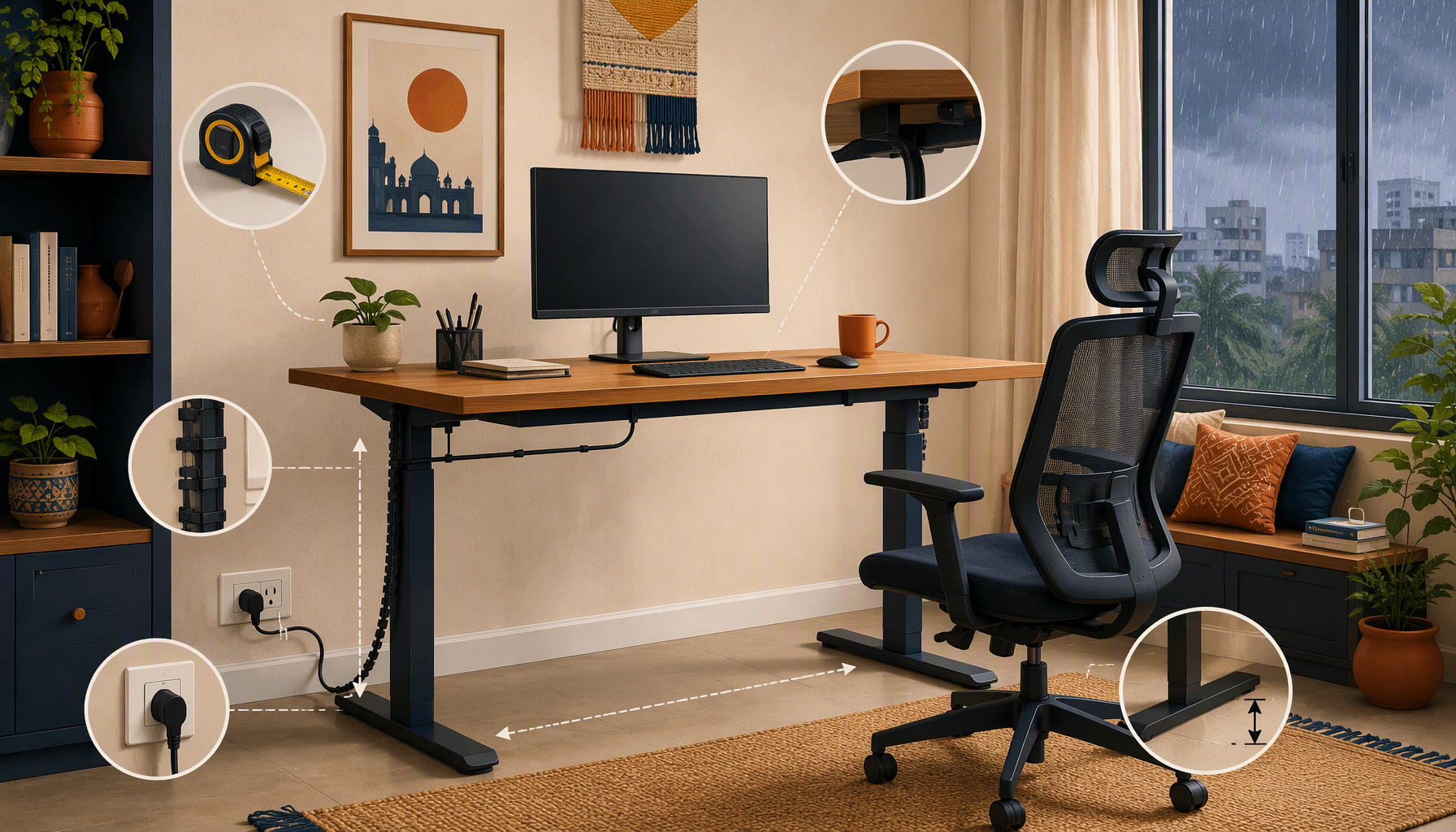
A standing desk can look like a productivity purchase and still fail because it does not fit the room, user height, monitor setup, power source, or service path. This guide is written for an Indian remote worker or home-office buyer and turns the shopping problem into a sequence of checks before a product shortlist.
What this decision requires
| Decision area | What to check | Why it matters |
|---|---|---|
| Room fit | Width, depth, clearance, doorway, floor, and cable route. | A desk that cannot fit the room is not a practical upgrade. |
| Height and stability | Height range, frame, load, wobble, monitor position, and seated use. | A standing option still needs a usable seated position. |
| Power and setup | Motor, plug, voltage, assembly, installation, and noise. | Setup and service are part of the purchase. |
| Ownership risk | Warranty, replacement, delivery damage, and return. | Large products can be expensive to send back or repair. |
Build the decision around the real situation
Begin with the room, not the product photo. Measure the available wall or floor area, doorway, chair clearance, monitor depth, cable route, and any nearby storage. A desk that fits the advertised dimensions may still make the room unusable when the chair, power strip, monitor arm, or walking path is included.
Height range is useful only when it covers the user’s actual seated and standing positions. Check the frame, load, stability, tabletop depth, monitor height, keyboard position, motor behavior, noise, and what happens if the mechanism stops. A wide range cannot compensate for a surface that is too shallow or a frame that wobbles at the needed height.
What not to assume from a listing
- A product photograph does not prove fit, comfort, durability, or suitability.
- A rating does not replace exact specifications, variant details, seller information, or returns.
- A low price does not prove low ownership cost.
- A “premium” or “versatile” label does not explain the actual tradeoff.
- A delivery promise must be checked for the intended pin code and current order date.
India-specific use and ownership
India-specific ownership includes voltage and plug compatibility, assembly, installation, delivery damage, replacement parts, and warranty support. Record the exact model and seller before comparing. The live standing-desk comparison can help with product shortlists after this decision framework, but the framework should come first.
Avoid buying because the desk promises productivity, shows a clean studio setup, or has the highest motor range. If room clearance, load, assembly, power, or warranty is unclear, pause.
Use a decision note before payment
Write down the option you are considering, the job it must do, the evidence that supports it, and the uncertainty that remains. If the decision depends on a measurement, seller promise, delivery date, warranty, or return condition, verify that item on the current listing rather than relying on an old comparison or a search snippet.
After purchase, keep the invoice, variant, warranty information, and return deadline together. If the product fails the original job, record the reason. That creates a better future decision and helps Bazaar improve its category guidance without inventing a test result or treating one shopper’s experience as universal evidence.
Before you order
- Record the exact product, seller, variant, price, and date checked.
- Verify the dimensions, fit, material, compatibility, care, warranty, and return path.
- Write one reason to buy and one reason not to buy.
- Check whether the item solves a genuine gap or duplicates something already owned.
- Re-check current terms immediately before payment.
Frequently Asked Questions
Is a standing desk suitable for every home office?
No. Check room clearance, user height, monitor position, cable routing, and whether alternating positions fits the actual routine.
What matters more: height range or stability?
Both matter. A wide range is not useful if the desk wobbles at the position you need.
Should the desk be the first home-office purchase?
Not always. Map the room, chair, screen, lighting, power, and work routine before buying furniture.